Still remember the days I was sitting at the round table in class, having an English lesson. I was trying to pay so much attention to what my teacher was teaching, trying to keep my eyes open and bobbing my head up and down, pretending I understood every nuance of the facts and grammar. But it was hard. Really hard.
“I have no idea what is going on” I thought, as I stopped nodding for a moment, squinted my eyes and then I nodded again. It was the only way to falsely indicate genuine interest and understanding.
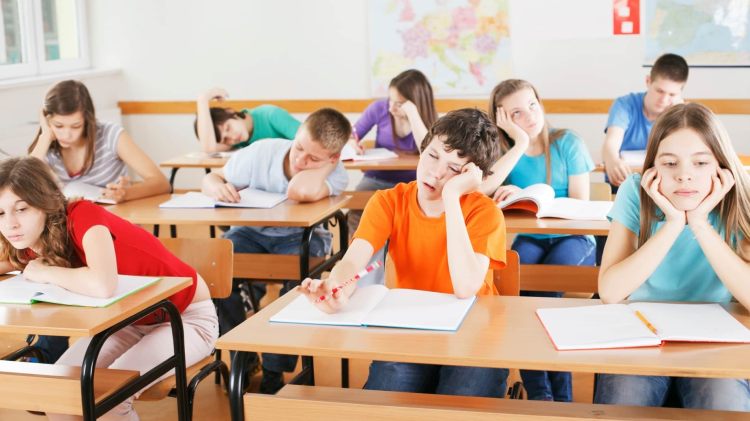
See, I was considered to be a great student and great students had to be silent at a round table along with other puppets who were struggling to hang on teacher’s every word. That was called “Collaborative learning” or, at least, it seemed that way.
I have to admit that. I was feeling victim to the epidemic of classroom boredom.
My classmates were bored, too. I could tell that! How come the teacher couldn’t?
They were fiddling with their pencils, scribbling notes to their fellow students, looking for distraction or they would be a distraction to others.
They were wondering..
“What time is it?”
“When does the bell ring?”
“Can I go to pee?”
I was also in their shoes since I desperately wanted to ask the same questions, but «great students» don’t do that.
I am not even sure why I was bored. Was it the teaching material that was monotonous, repetitious or the teacher himself with his obsolete teaching strategies?
The only thing I can assure you of was the thought that I was dreaming to become an inspiring teacher who would passionately teach in ways that would motivate students. I was dreaming to empower students with voice and choice so that they could be engaged in whatever they were learning. I was dreaming to change the world.
My best friend, Vasia, suggested I should become a politician but I chose the teacher’s job. If you want to change the world, start from education. Help children speak for themselves freely, logically, independently and they will be able to become useful members of society, make the world go round.
As Nelson Mandela well said “Education is the most powerful weapon which you can use to change the world” (Mandela, 1990). To change the world means changing the way of your thinking, your habits and actions. Be equipped to make decisions based on a thorough knowledge base. Be equipped to lead your life appropriately without social discrimination, take for example, racism, or violence. Be emotionally well-developed so that you can lead your life no matter what path you follow.
As a teacher myself, I felt like a drop in the ocean. It’s so difficult to change the structures that have been sturdy for so long. However, it’s not impossible.
I’m not here to tell how to teach. I’m certain that you are a special architect of your job, you are an artist. You know your subject and your students better than anyone else so that you can turn them into designers and problem-solvers that can have a massive impact on the world. But as you know, makers need tools. That’s why, I’m here! To share my ideas on how students can be better engaged in the learning process, how they can gain knowledge and skills that will help them lead to their passion or how they will get rid of the feeling of boredom during class lessons.
Let me give you 5 ways to overcome school boredom
- A key way to fuel students’ motivation is to let them collaborate. Leave traditional teaching methods behind by which teachers are the transmitters of knowledge and encourage them to take on responsibility for their own learning. Students can work together, interact with each other and actively construct their own knowledge by examining the subject and critically reflect on it.
They will face problem-solving tasks, crucial decisions, will hopefully argue, persuade, and criticize their views…
I love the battles with arguments. True.
Even the more shy learners will feel confidence and less anxiety so that they can freely express their views and be led to deeper learning.
Yeah, this is definitely it. A learner-centered approach.
And of course, the round tables in the classroom will be finally used appropriately. - And what about Project? I get excited about the idea that students can gain language acquisition based on the principle “Learning by doing” (Gal & Garfield, 1997). They can raise their voice and choose a theme in conjunction with the teachers based on their interests (Gal & Garfield, 1997). For instance, they can carry out research on human rights, collect and assess data arising from an area of their interest and think critically (Griva & Chostelidou, 2017).
- Create a mystery: At the beginning of the school year, bring a decorated suitcase full of games, paper crafts and quizzes. When you introduce a new lesson, take the appropriate material from the suitcase. This is a fun way to trigger students’ curiosity.
- Add music: Divide students into groups and invite them to clap out the rhythm. Change the lyrics of a popular song so that students are better engaged in the learning process.
- Use real life objects: Bring real fruit into class and describe it, talk about healthy and non-healthy food.
You should always bear in mind that you are an inspiring teacher and you have all the means to discover and transmit better social constructions along with your students.
Stop practicing boring book learning by heart and make them focus on real life and creative projects.
Make them think out of the box.
REFERENCES
Gal, I. & Garfield, J. B. (1997). The Assessment Challenge in Statistics Education. IOS Press. Pages 139-151. Copyright holder: International Statistical Institute. Permission granted by ISI to the IASE to make the chapters from this book freely available on the Internet. Retrieved January 5, 2019, from https://iase-web.org/documents/book1/chapter11.pdf.
Griva, E. & Chostelidou, D. (2017). CLIL in Primary Education: Promoting Multicultural Citizenship Awareness in the Foreign Language Classroom. Research Papers in Language Teaching and Learning. Retrieved January 4, 2019, from http://rpltl.eap.gr/images/2017/08-02-009-Griva-Chostelidou.pdf.
Mandela, N. (1990). Education is the most powerful weapon which you can use to change the world. Boston: Madison Park High School.
 Love your English
Very nice ideas! Sure children are the future so as educators we should focus on teaching them in a way that they will stay engaged and learn in the best way possible. Loved the mystery idea
Μου αρέσει!Αρέσει σε 1 άτομο
More ideas are coming.. thanks ❤️
Μου αρέσει!Μου αρέσει!
Really nice and practical ideas! Thank you for sharing them with us.
Μου αρέσει!Αρέσει σε 1 άτομο
Oh, my pleasure ❤️
Μου αρέσει!Μου αρέσει!
Wonderful blog! Very informative and helpful for teachers. It seems very well-researched. Keep up the good work!
Μου αρέσει!Μου αρέσει!
Thank you, I’m glad you enjoyed it!! My job is my hobby! I really love it! 💙
Μου αρέσει!Αρέσει σε 1 άτομο