While most people in the past were horrified at the thought that their child had developed a mental disease because they noticed symptoms like slow reading, trouble spelling or messing up words in their children’s literacy behavior, nowadays parents know better than shunning or regarding their children as if they are mentally retarded: Dyslexia, which is not an incurable disease but a specific learning disability which once being diagnosed can be confronted, is a lifelong condition that makes it difficult for children to read.
What is dyslexia?
Although it is difficult to provide an accurate definition of the term “Dyslexia” as it is a very versatile and controversial term subjected to change at the course of time (Amesbury, 2006-7), according to the International Dyslexia Association (IDA), dyslexia is a specific learning disability that is neurobiological in origin and is characterized by trouble with word recognition, spelling and writing words (Troeva, 2016). These troubles are associated with a deficit in the phonological competent of language without affecting cognitive abilities (Troeva, 2016). There may be difficulties in reading comprehension, as well as vocabulary and background knowledge being slowly progressed (Troeva, 2016). So dyslexia affects spoken and written language and it is a lifelong disorder which can be treated but it never completely disappears as it is not “outgrown” (Tsigka, 2018).
What happens in the brain of children with dyslexia?
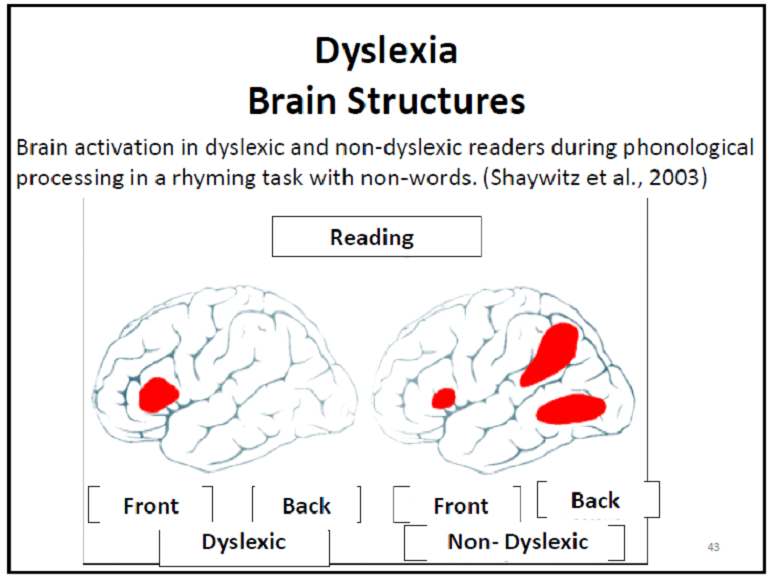
Dyslexic brains work harder, up to 5 times more than the brain of other children when they have to carry out the same linguistic test. Regardless of their normal IQ, dyslexics have difficulty in understanding that one word consists of smaller units. This is why, most dyslexics have difficulties in reading. As shown in the picture, there is natural difference in the brain structure by birth and thus, language is perceived differently by dyslexics in contrast to non-dyslexics.
What are the signs of dyslexia?
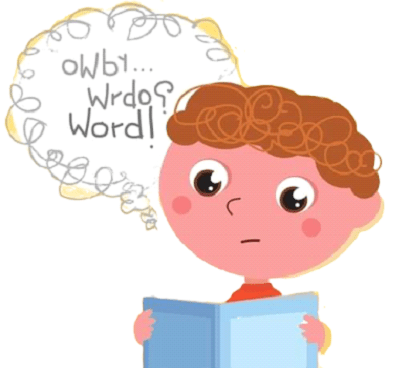
- Errors in reversals (b/d, p/q), transpositions (was/saw, scared/sacred), inversions (m/w, u/n), and omissions (place instead of palace).
- Poor spelling skills, lack of recognition of patterns of words (like, mile).
- Difficulty in learning basic sight words (the, who, what, laugh).
- Slow reading which can affect comprehension of material.
- Pronounce a word many different ways within the same text.
- Difficulty in recalling words for both oral and written expression.
- Low self – esteem.
What are the symptoms of dyslexia?
Some symptoms in preschoolers
- Delayed speech.
- Problems with pronunciation.
- Difficulty in writing their names, learning colors and numbers.
- Struggle with learning rhymes, prefixes or suffixes.
Some symptoms in primary school children
- Confusing letters when writing such as ‘b’ and ‘d’.
- Write words backwards, such as “nip” instead of “pin”.
Some symptoms in high school children
- Poor reading and spelling.
- Difficulty in writing summaries.
How is dyslexia treated in classroom?
- Ehri offers a four-phase model of reading development
- Beginners start learning the names and sounds of the letters in the alphabetic system.
- start forming full connections between graphemes and phonemes.
- decode unfamiliar words and retain spelling of words they have already seen several times in their memory.
- retain sight words in their memory and that makes the acquisition of new words easier.
- Time
- Children with dyslexia need time for task completion. Language abilities are necessary in order to understand the meanings of words, their semantic, syntactic processes and to integrate all this information into texts.
- Grouping
- Effective teachers create academic groups with different potentials, different academic backgrounds and not “fixed ability groups”.
- Multisensory techniques
- It is highly recommended for children with dyslexia as it involves four sensory modalities –oral, visual, auditory and kinesthetic-tactile and it enhances memory, weak modalities, enforces strong one and creates automaticity.
Do pupils with dyslexia follow the same process of learning when reading?
This depends on the child. Some children with dyslexia develop reading skills following the same stages as other children.
Whenever I am thinking of dyslexia, two things are coming to my mind:
“Tell me and I forget. Teach me and I remember. Involve me and I learn.”
– Benjamin Franklin
Dyslectic children are perfectly capable of succeeding in school and achieve a high performance score. You may have your doubts, but keep that: the key to success is proper guidance.
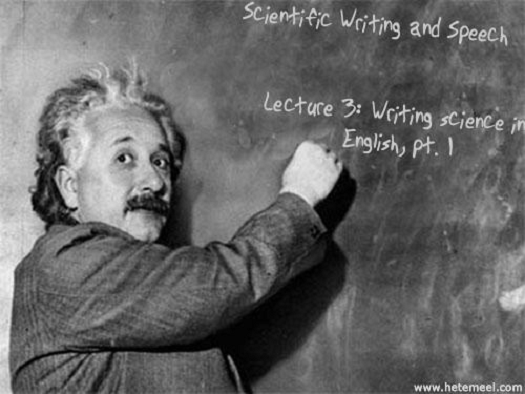
And
“Einstein”
References
Amesbury, L. (2006/2007). Dyslexia: a holistic review of the strengths and difficulties. [online] Available : https://core.ac.uk/download/pdf/1931979.pdf.
Freereading.net. (n.d.). Ehri’s Four Phases of Word Reading – FreeReading. [online] Available at: http://www.freereading.net/wiki/Ehri’s_Four_Phases_of_Word_Reading.html
Graham, S., Karen R. H. & Larsen L. (n.d.). Prevention and Intervention of Writing Difficulties for Students with Learning Disabilities. All about learning disabilities and ADHD. Available at: http://www.ldonline.org/article/6213/.
GreatSchools Staff. (2013). Structural brain differences in kids with dyslexia. [online] Available at: https://www.greatschools.org/gk/articles/structural-brain-differences-in-kids-with-dyslexia/.
Hudson, R. F., High, L. & Al Otaiba, S. (n.d.). Dyslexia and the Brain: What Does Current Research Tell Us?.All about learning disabilities and ADHD. Available at: http://www.ldonline.org/article/14907/.
Troeva, B. (2016). The Process of Reading and the Teaching of Reading Skills to pupils with dyslexia. Pedagogy Critical Approaches to Teaching Literature Language Composition and culture 88 (3) [online]. Available at https://www.researchgate.net/publication/301487593_The_Process_of_Reading_and_the_Teaching_of_Reading_Skills_to_Pupils_with_Dyslexia
Tsigka, S. (2018). Learning Disorders…or Disabilities…or Differences PowerPoint slides. Unpublished manuscript, LIN 327, European University of Cyprus
 Love your English
Very well-researched, Nikoletta, and very enlightening!
Well done!
Μου αρέσει!Μου αρέσει!
Thank you for sharing and educating on dyslexia! My son has dyslexia and my daughter has a reading disability (in all reality she did well enough by a point or two to not be considered dyslexic). School is a challenge for both of them and I find myself counting the days for summer vacations, weekends and any time that we can take a break. Remote learning has proven to be an even bigger challenge as it requires even more reading. My kids thrive with hands on instruction, like most dyslexic minds they learn by doing!
Μου αρέσει!Μου αρέσει!