If you are reading this post now, you probably read my mind. You probably are one of the teachers that feel satisfied at the end of the delivery course. And why shouldn’t you be? You have taught all the norms of Present Simple and Present Continuous. You have given and explained all the examples to compare these two tenses. You rock! Your smile on your face tells me a lot. It’s like you have conquered the world.
But then it comes the crucial moment that you make the well-known, the very specific question “Well, guys. Let’s recapitulate. What have we learned today?.” Suddenly they stop looking at you. They’re in search of something. You notice them. They open their pencil cases, their bags or look at the floor. What are they looking for??? Some of them are puzzled, lost in thoughts. They’re with eyes open in amazement/worry. You’re waiting patiently for an answer. Poor you. They will not tell you a thing and you start realizing that.
The next lesson comes. Plan B works. You’re fully prepared for that. And do you know why? Because you have decided to enhance their English alternatively.
First, let’s have a look at the differences between Present Simple and Present Continuous.
Present Simple
- Daily routines or habits I play basketball on Saturdays.
- General truths It rains a lot in autumn.
- Permanent situations I live in Greece.
- Timetables/schedules The show starts at 3:00
Present Continuous
- Action in progress I am playing basketball now.
- Action happening right now It is raining right now
- Temporary situations I am living in Italy at the moment.
- Future arrangements I am meeting you at the show.
Stative verbs
They are verbs that express a state rather than an action. They relate to feelings (love, like, hate, prefer, want), senses (see, hear, smell, taste, seem), thoughts (know, believe, understand, remember, forget) etc. These verbs are used with Present Simple even though the action takes place now/ at the moment. However, there are some verbs which look like stative verbs, they can be used in Present Continuous and they differ to the meaning. They’re called dynamic. For instance,
- think -> have an opinion
- see -> see with your eyes/understand
- have -> own
- taste -> has a certain taste
- smell ->has a certain smell
- be -> be
- be thinking -> consider
- be seeing -> visit
- be having -> part of an expression
- be tasting -> the action of tasting
- be smelling -> the action of smelling
- be being -> behave
As for the fourth rules, Greek students are often getting confused because both of them refer to programs. However, Present Simple refers to a neutral program “The film/the show/it starts at 3:00” whereas Present Continuous refers to a personal program. The example of the Simpsons will be definitely etched on students’ minds. https://getyarn.io/yarn-clip/60fdb4f7-4c36-4655-ae99-64f9c8c16896
Activities for Present Simple/ Present Continuous
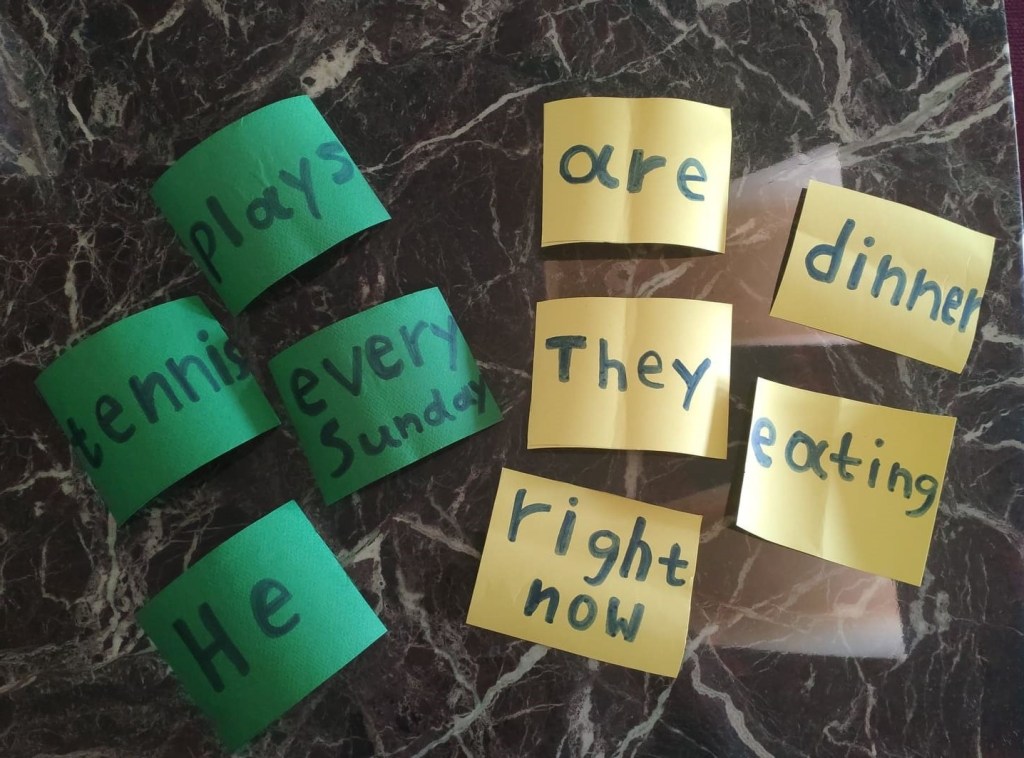
Click on word make a sentence!
Divide students into groups and give them different words. Students should create sentences by putting the words in the right order. Use an hourglass to create suspense and check their scores and speed.
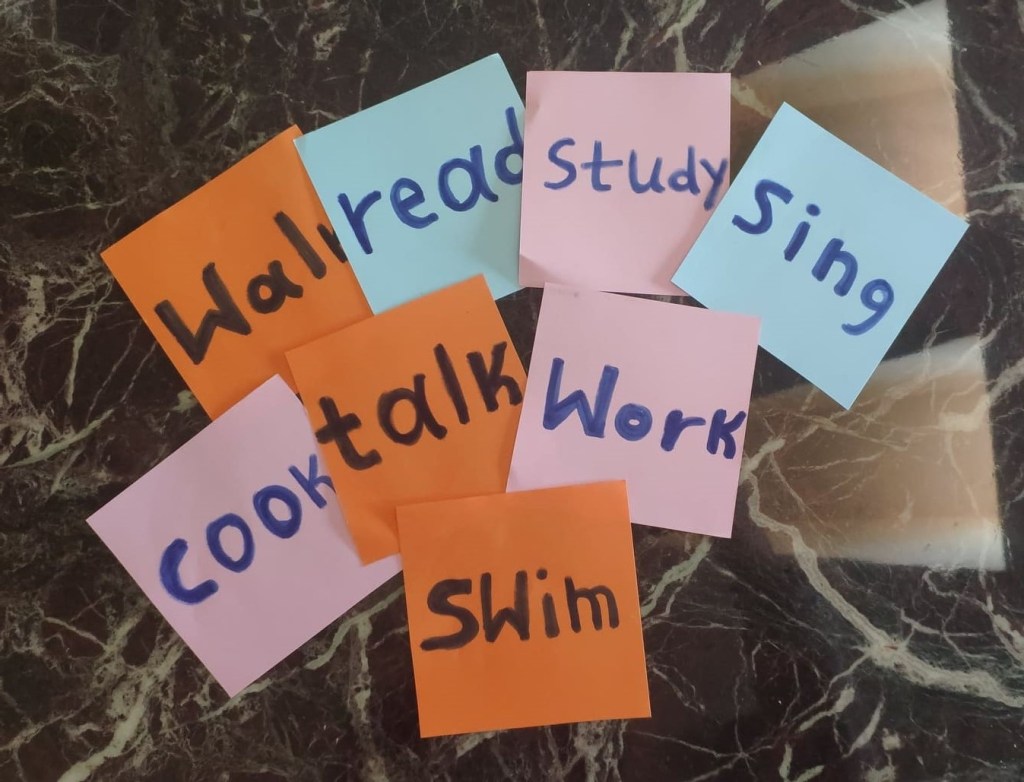
Lucky bag!
Every student pulls a word from the lucky bag and tries to make his own sentence by using Present Simple and Present Continuous.
⦁ Partly Cloudy- Describe the video
In a story, Present Continuous is used for the background information and Present Simple for the action. https://www.youtube.com/watch?v=7DmLkugdh9s
First watch the entire movie “Partly Cloudy” with the students and then, watch it with pauses and simultaneously comment on it. Ask students to describe it on their own. Give key words: birds, baby cats, baby dogs, baby crocodile, cloud, cry, afraid, happy, angry
⦁ Sing with me “All of me” – John Legend
Ask students to complete the lyrics with the words missing.
How many times ____________ to tell you.
Even when you ___________ you’re beautiful too.
The world __________________ you down.
I’m around through every mood
You’re my downfall, you’re my muse
My worst distraction, my rhythm and blues
……..
Sing with me once again, it’s for Elias “Thinking of you”.
Identify the stative verbs and dynamic verbs and talk about their differences .
When I, when I’m thinking of trouble
God knows I’m thinking of you
When I’m falling down
When I go out of my mind
God knows I’m thinking of you
God knows I’m thinking of you
After all this time
I still feel the pain
When you left me all alone
To take the blame
Did you run out of love?
Or just run out love?
Still got a heart-shaped bruise
That’s how I remember you
Present Simple vs Present Continuous
Easy- Peasy
 Love your English
This article reminded me of my school years… When teachers asked me even a very simple question e.g. «can you say the ‘d’?» I was puzzled… Almost always.. I thought if I could actually do it…
Your proposals are great as you don’t put your students in accusatory positions. Students get relaxed during fun activities and are thrilled to participate! Even the most shy of them can feel free to take part in these!!
Keep up the GREAT work!
Μου αρέσει!Αρέσει σε 1 άτομο